Portugual Empire in the East
1502 to 1739
Portugal — versus — Arabs, Ottomans, Egyptians, Indian Rajas
Exploration of West Africa — 1419-1499Portuguese Conquest of South Asia — 1503-1557
Decline of the Portuguese Empire in the East — 1600-1796
Introduction
 |
By the seventeenth century the Portuguese trading empire in the east began to decline. The Dutch East India Company was established in 1602 and within a few generations had conquered many Portuguese trading ports, less by arms than by more agressive trading practices. Portugal continued to loose influence in the region for the next few centuries until the 1770's when the French and Mysoris conquered many of Portugal's remaining holdings on the Malabar coast of India. Their primary portt at Goa, however, remained in Portugal's hands until 1961 when it was peacefully ceded to the Indian government.
Exploration of West Africa : 1419-1499
 |
From the conquest of Ceuta in 1415, until Bartholomew Diaz's famous voyage around the Cape of Good Hope in 1488, Portugal made steady progress in trade, colonization, and missionary activity along the West Coast of Africa. Portuguese colonies on the west coast of Africa include:
| Year | Landmark | Location |
|---|---|---|
| 1415 | Ceuta Island | South of Spain |
| 1419 | Madeira Islands | West of Morocco |
| 1427 | Azore Islands | West of Portugal |
| 1434 | Cape Bojador | Western Sahara |
| 1441 | Senegal River | Senegal |
| 1445 | Cape Verde Islands | West of Senegal |
| 1475 | Bight of Benin | Gulf of Guinea |
| 1482 | Congo River | Congo |
| 1486 | Cape Cross | Namibia |
| 1488 | Cape of Good Hope | South Africa |
| Date | Battle Summary | |
|---|---|---|
| Battle of Ceuta (First )
Portuguese victory
Fought August 14, 1415 between 45,000 Portuguese invaders led by Prince Henry the Navigator and the Moorish defenders of the city. The Moors were caught off guard and the Moorish trading post located on an island south of Spain was captured by nightfall. | ||
| Made improvements in navigation, ship building, map-making. Organized sailing expeditions along the coast of Africa. | |
| Discovered Cape of Good Hope at the southernmost point of Africa. | |
| Early Portuguese explorer under Prince Henry the Navigator, who discovered Cape Verde and Gambia river. | |
| Portuguese explorer, sent by Henry the Navigator, who sailed as far south as Guinea in 1445. | |
| Portuguese explorer who discovered the Congo river and sailed as far south as Angola. |
Portuguese Conquest of South Asia : 1503-1557
 |
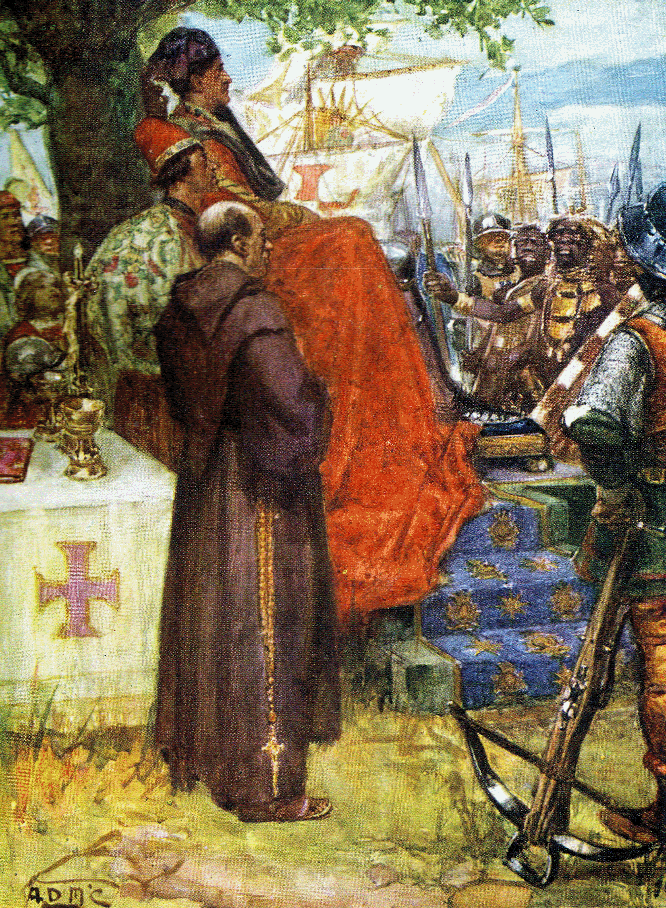
Two years after da Gama returned from the East he lead a second expedition, this time with 20 warships. The Portuguese agressively resisted the Arab traders, seized and sank many of their ships and forced the Zamorin of Calicut to agree to a treaty permitting Portuguese trade in the area. Hardly had he returned that Francisco Almeida led another fleet to the east. This time, he conquered or destroyed every Arab trading post along Eastern Coast of Africa, and immediately upon his arrival in India, organized more exploration and military expedititions. Almeida prevailed in numerous battles with the Arabs, and engaged in considerable piracy. In the Battle of Diu, 1509, all of the Arab forces, including their allies in Egypt, India, and even Venice were arrayed against the Portuguese, but they prevailed handily.
Almeida, the first governor of India was a worthy successor to Vasco da Gama, but Afonso Albuquerue, who followed him, was even more aggressive in his conquests. Almeida had permanently established Portuguese presence in the Far East, but Albuquerque, in his short reign of only six years, drove the the Arabs from the East and nearly conquered their home base. He fought Arabs from the Red Sea, all along the Malabar Coast, to the Spice Islands. He conquered Goa (1510) on the Western Coast of India, and Malacca (1511) in Malaysia, the two largest trading posts in the region, and even took the island of Hormuz (1507) off the coast of Arabia.
The governors that followed Almeida and Albuquerque were less impressive, but the Portuguese held their posts when the Ottomans regrouped and attacked Dui and Goa several decades later on. The Portuguese also established trading posts in Macau, China and Nagasaki, Japan and other locations in Indonesia, India, and Africa. Because of their superior ships, they came to control much trade between eastern countries as well as between the east and the west. A list of major Portuguese trading centers follows.
| Established | Location | Year Lost | Lost to Whom |
|---|---|---|---|
| 1503 | Cochin, Malabar Coast | 1773 | Mysoris, aided by the French |
| 1505 | Colombo, Sri Lanka | 1658 | Dutch East India Company |
| 1507 | Hormuz, Persian Gulf | 1622 | Persia, aided by England |
| 1509 | Dui, Malabar Coast | 1961 | Ceded to Independent India |
| 1510 | Goa, Malabar Coast | 1961 | Ceded to Independent India |
| 1511 | Malacca, Malaysia | 1641 | Dutch East India Company |
| 1513 | Maluku (Spice Islands) | 1646 | Dutch East India Company |
| 1534 | Bombay, Malabar Coast | 1661 | Ceded to Britain as a Dowry |
| 1542 | Nagasaki, Japan | 1637 | Takugawa Shogunate, aide by Dutch |
| 1557 | Macau, China | 1974 | Ceded to People's Republic of China |
| Date | Battle Summary | |
|---|---|---|
| Battle of Goa
(East India Conquest )
Portuguese victory
In 1511, Goa, held by a Portuguese garrison, under Albuquerque, was invested by Kumal Khan, General of the Rajah of Bijapore, at the head of 60,000 men. After a siege of 20 days Albuquerque found his communication with his fleet threatened, and withdrew the garrison. In the same year, however, having collected a force of 1,500 men with 23 ships at Cananore, he attacked Goa, and at once forced an entrance. After severe fighting in the streets, the Deccanis fled in confusion to the mainland, with a loss of 6,000. The Portuguese lost 50 only. | ||
| Battle of Malacca (East India Conquest )
Portuguese victory
This city, which was defended by 30,000 Malays, under the Sultan Mohammed, was captured by Albuquerque, with 19 ships and 1,400 Portuguese regulars, after a very feeble defense, in 1513. | ||
| Battle of Diu (East India Conquest )
Portuguese victory
This fortified Portuguese factory was besieged early in September, 1537, by a fleet of 76 Turkish galleys, and 7,000 soldiers under Solyman, Pasha of Egypt, acting with whom was an army of 20,000 Gujeratis under Bahadur Shah, and Khojah Zofar, an Italian renegade. The garrison of 600, under Antonio de Silveira, repulsed assault after assault, but were nearly at the end of their resources, when the false rumour of an approaching Portuguese fleet caused Solyman to withdraw. | ||
| Siege of Diu (East India Conquest )
Portuguese victory
In 1545 Diu was again besieged by the Gujeratis, the garrison being commanded by Mascarenhas. Khojah Zofar, who led the besiegers, was killed in the course of the siege, and was succeeded by Rami Khan. The garrison, at the end of several months, was on the point of surrendering, owing to famine, when it was relieved by Juan de Castro, who signally defeated the Gujeratis, and raised the siege. | ||
| Siege of Goa (Mahratta conquest )
Portuguese victory
This fort, which was held by a Portuguese garrison of 700, under the Viceroy, Luis de Ataida, was attacked by Ali Adil Shah, Rajah of Bijapore, with 135,000 men and 350 guns, in 1570. Aided by the civilians, and 1,300 monks, the garrison made so strenuous a defense, that the Rajah was beaten off, after losing 12,000 men. | ||
| Portuguese explorer who voyaged to Calicut, India by sailing around the Cape of Good Hope in South Africa. | |
| Portuguese general who served in the wars against Granada, and was appointed the first governor of Portuguese India. | |
| Portuguese commander who won numerous naval conflicts in Asia and helped establish a colony in India at Goa. | |
| Portuguese explorer who served as governor of India, and died searching for Gold in South Africa. | |
| Portuguese naval commander, who aided his father Francisco, in his conquests in India. |
Decline of the Portuguese Empire in the East : 1600-1796
 |
A few open conflicts did occur between the trading companies, particularly in Malaysia and
the Spice islands, where the Dutch aggressively established control in the 1640's.
The most dramatic loss of Portuguese influence during this era, however, was in Japan.
When the Takugawa Shogunite came to power, it
drove the Portuguese out of mainland Japan and murdered thousands of newly converted
Christians, before closing its door on trade to countries but Holland. The main Portuguese
stronghold, however, remained the Malabar coast in India, but this declined over time
as the French and British gained influence in the region. Nevertheless, Goa and Dui, two of the oldest
Portuguese ports in the east, were not ceded to the Indian government until 1961, and
Macau, an island off the coast of China, was not ceded to the Chinese until 1974.
| Date | Battle Summary | |
|---|---|---|
| Siege of Vasai (West Coast Africa )
Marathas victory
This Portuguese fort was besieged by the Marathas, led by the brother of Baji Rao I, in 1739. The fort was taken and the Portuguese were driven from the surrounding area. | ||
Image Links | ||
|---|---|---|
Vasco da Gama meets the Zamorin of Calicut in Famous Men of Modern Times |
 Vasco da Gama landing at Kalicut in India: Peeps at History |
D'Azambuja receiving the Native Chief at Elmira in The Land of the Golden Trade |
 Alfonso de Albuqurque in Albuquerque: Rulers of India |
 Vasco de Gama in A Book of Discovery |
 A Ship of Albuquerque's fleet in A Book of Discovery |
 A Ship of Vasco De Gama's Time in European Hero Stories |
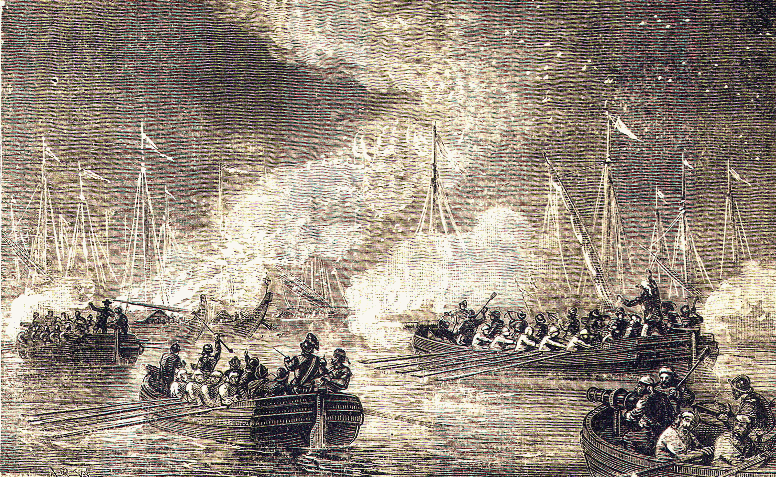 The attack on the Goa Boats in The Adventures of Vasco da Gama |
|