Spanish Conquest of Peru
1526 to 1546
Spanish Conquistadors — versus — Incan Empire
Inca Civil War — 1529-1532Conquest of the Incas
Rebellions
 |
The central character of the Spanish conquest of Peru was Francisco Pizarro, an adventurer who was regarded as
particularly unsavory even
among conquistadors. Treachery and brutality towards the natives were considered minor offenses during
the age of conquest, but disloyalty and perfidy towards one's fellow Spaniards were regarded as serious wrong-doing. It is
therefore of some comfort that Pizarro himself came to a bad end shortly after his spectacular, but inglorious triumph
over the Incas.
Inca Civil War : 1529 to 1532
 |
The ruler of the Incas was said to be descended from the Sun-god and had absolute power over the region. The excessive reliance on a single, hereditary leader, however, proved to a terrible weakness when the Spaniards succeeded in getting the "Inca" into their power. And the fact that at the time of the invasion the Incas were engaged in a civil war between two brothers, both contending for supreme power, sealed their fate. The previous Inca, Huayna Capa, died in 1527, but instead of leaving his entire kingdom to Huascar, his rightful heir, he provided that the northern portions, be left to Atahualpa, the son of a local princess who was his favorite mistress. The empire was therefore divided between Atahualpa, who had his capital in Quito, and Huascar, whose capital was Cuzco.
The brothers co-existed peacefully for a short while, but eventually Huascar sent an army to reclaim Quito. Atahualpa was captured, but quickly escaped, and shortly after several of the leading generals of Huayna Capa went over to Atahualpa. At this point, sometime around 1530, open war broke out. The first major battle was at Chimborazo wherein Atahualpa and his loyal generals, Quizquiz, Chalkuchimuc, and Ruminahui soundly defeated Huascar. The three later played important roles in resisting the Spanish, and their allegiance Atahualpa during the civil war was critical to his success. The final battle of the Incan civil war was fought at Quipaipan in April 1532, about the same time the Spaniards set up a camp on the Peruvian coast. After this battle, Huascar was captured and imprisoned. At this point Atahualpa, newly victorious and unafraid of the small band of Spaniards still camped near the coast, invited the foreigners to visit him at his camp outside Caxamalca.
| Date | Battle Summary | |
|---|---|---|
| Battle of Chimborazo (Civil War of the Incas )
atahualpa victory
Fought 1531, between a northern army supporting Atahualpa, led by his generals Quizquiz and Chalcauchimac and the southern Incas, supporting the Huascar, the rightful heir, led by Atoc. The superior forces under the Atahualpa's generals won the day and captured and tortured Atoc. | ||
| Battle of Ambate (Civil War of the Incas )
atahualpa victory
Fought 1532, between the two Peruvian chiefs Atahualpa and Huascar, in which the latter suffered a complete defeat. | ||
| Battle of Quipuaypan (conquest )
atahualpa victory
Fought 1532, between the rival Peruvian chiefs, Atahualpa and Huascar. Huascar was totally routed, and taken prisoner. | ||
| Last monarch of the Incan Empire. Captured by Pizarro at Caxamalca and eventually killed. | |
| Half-brother of Atahualpa who contended with him for the throne of the Incas. | |
| Commander of the Incan army under Huascar. | |
| Leader of the armies of Atahualpa during the Incan Civil War, who refused to submit to the Spaniards. | |
| Leader of the armies of Atahualpa during the Incan Civil War, who was captured by the Spaniards. |
Conquest of the Incas
 |
In 1512, Balboa and his followers founded the city of Darien on the west coat of Panama. Shortly thereafter the Spaniards began to hear rumors of a wealthy empire to the south, but at the time the geography of the continent was entirely unknown, and it was unclear whether this fabulous kingdom even existed. Pizarro was one of the original soldiers who accompanied Balboa on his discovery of the Pacific Ocean, and he heard of these rumors as early as 1513. Balboa spent the last few years of his life on the southern coast of Panama, building ships for an expedition to South America. He was treacherously killed in 1519, and the new governor Pedrarias, with Pizarro as his chief henchmen, took over Balboa's settlement at Panama city with hopes of leading an expedition in search of the mysterious southern kingdom.
The project proved much more difficult than expected. Gold had recently been discovered in Mexico so adventurers and investors were difficult to recruit. The South American coast was difficult to reach, the coastline was treacherous, and supplies were very difficult to transport over the Isthmus. When Pizarro and his partners finally did succeed in sending an expedition it suffered many hardships and returned without venturing any further than the coast of Columbia. Pizarro led the expedition, but his partner Almagro played just as important a role as chief provisioner. Neither, however, was discouraged by the failure of the first voyage, and set about planning for a second expedition.
With the reluctant support of the local Spanish governor, they finally succeeded in organizing a second expedition. This was more successful. They sailors succeeded in locating a coastal tribe that was actually ruled by the Incas, and acquiring samples of gold and linen from a native ship. They too, however, suffered great hardships and lost many men. As a result the Spanish governor withdrew support, and ordered the mission to return home. Upon hearing this order, Pizarro refused to obey, and with a band of 13 men, continued his quest. Pizarro resolved not to return until he had a better idea of the location of the Incan empire, and this time he succeeded in obtaining first hand information of the location of the Incas, and spectacular samples of gold and silver, impressive enough to win the backing of the Spanish Crown.
The third and final expedition reached the coast of Peru in 1531. The first military encounter was with a native tribe on the island of Puna. The Spanish prevailed, but it took them nearly a year to establish a permanent camp on the coast of Peru. Then, by a great stroke of luck the Inca allowed the Spaniards to send an embassy to his camp. Instead of having to fight their way up the mountains, therefore, they were invited in the heart if Inca territory. Atahualpa, with over 100,000 troops was not threatened by the Spanish force of less than 200, so they ascended the mountains unmolested. The Spaniards returned this graciousness with a despicable act of treachery, and by way of the massacre at Caxamalca, got the Atahualpa into their power. Pizarro held him in captivity for over a year, and by doing gained control over much of the empire. Eventually the Inca was considered too dangerous to leave alive so he was executed on the trumped up charge of murdering his brother Huascar, the "rightful" Inca. The Spaniards then place a puppet Inca on the throne, and continued their conquests by taking the capitals of Cuzco, in 1533, and Quito (battle of Chimborazo) in 1534.
After the death of the Inca, several of Atahualpa's generals took matters into their own hands. Quizquiz was especially notable for resisting the Spaniards at Cuzco, and Ruminahui burned Quito rather than let it fall into enemy hands. Nevertheless, the Spaniards were irrepressible, and within two years were seemingly in firm control. However, one of the "puppet" Incas that the Spaniards had enthroned was plotting against them. In 1536 Manco Inca Yupanqui, one of the many brothers of Atahualpa and Huascar, led over 100,000 Incan warriors in a revolt against the Spanish overlords. He besieged the city of Cuzco for over six months and killed one of the Pizarro brothers before being driven away by Spanish reinforcements. Manco Inca escaped and formed a rebel colony deep in the mountains which was not conquered by the Spanish for almost forty years. The last Inca was Manco's son, Tupar Amaru who died trying to uphold the last vestige of Incan independence.
| Date | Battle Summary | |
|---|---|---|
| Battle of Puna (conquest )
Spanish victory
Fought April 1531 when 3000 native warriors on the island of Puna attacked the camp of 160 Spaniards. The superior arms and discipline of the Spaniards won the day and over 3000 natives were slaughters with the loss of only three Spaniards. | ||
| Battle of Caxamalca
(conquest )
spanish victory
Fought 1531, between 160 Spaniards under Pizarro, and 30,000 Peruvians, forming the escort of the Inca, Manco-Capac. The battle was nothing but a butchery, Pizarro, who had invited the Inca to visit him, falling upon the unsuspecting Peruvians, seizing Manco-Capac, and slaughtering 4,000 men, without the loss of a single Spaniard. | ||
| Battle of Cuzco
(conquest )
Spanish victory
Fought August through November, 1533 between300 Spaniards, led by Pizarro and his brothers, and a large force of Incas, led by the Incan general Quizquiz, fighting on his own volition after Atahualpa was killed. Quizquiz ambushed the Spaniards at a mountain pass on the approach it Cuzco, and inflicted considerable casualties, but was ultimately overcome by the smaller force. The battle continued outside the capital until Quizquiz fled. | ||
| Battle of Maraycalla (conquest )
Spanish victory
Fought in early 1534 several months after the fall of Cuzco, between the Spaniards, led by the Pizarro brothers and Incas led by Quizquiz. The battle went badly for the Incas and Quizquiz was slain by his own men who opposed continued resistance of the Spaniards. | ||
| Battle of Chimborazo (conquest )
Spanish victory
Fought between an army of Spaniards, led by Belalcazar, and an Incan army, who still held Northern capital of Quito, led by Ruminahui. After a fierce fight, the Incas were defeated, but Ruminahui burned the town and refused to divulge the location of the Incas gold even under torture. | ||
| Siege of Cuzco
(conquest )
spanish victory
This city was besieged 1536, by 200,000 Peruvians, under Manco Inca and was defended by 250 Spaniards under Juan and Gonzalo Pizarro. After a siege of five months, Almagro, to whom certain of the conquered territories had been assigned by the king of Spain, arrived with his troops, and attacked and totally routed the Peruvians. He then laid siege to the place on his own account, and shortly afterwards compelled Gonzalo Pizarro to capitulate. Juan died in the course of the siege. | ||
| Battle of Ollantaytambo (Inca Rising )
incas victory
Fought between 100 Spaniards under Hernando Pizarro, and 30,000 Incas under the rebel Manco Inca who led an attack against the Spanish-held city of Cuzco. After Spanish reinforcements arrived, they attacked Manco's headquarters at the town of Ollantaytambo, but failed to dislodge the Incas. | ||
| With only 160 men, conquered six thousand Inca and took control of Peru. | |
| Adventurer who aided in conquest of Peru, then explored Southwestern United States. Discovered Mississippi river. | |
| Last monarch of the Incan Empire. Captured by Pizarro at Caxamalca and eventually killed. | |
| Brother of Francisco Pizarro; led an expedition from Quito across the Andes and discovered the Amazon. | |
| Spanish soldier who partnered with Pizarro, providing ships, men, and provisions for the Incan Conquest. | |
| Brother of Francisco Pizarro who died during the Siege of Cuzco. | |
| Brother of Francisco Pizarro who was imprisoned in Spain upon his return. | |
| Incan Warrior who continued to fight the Spanish and burned Quito rather than surrender. | |
| Leader of the armies of Atahualpa during the Incan Civil War, who refused to submit to the Spaniards. | |
| Ruler of the Incas, crowned by the Spaniards who rebelled and laid siege to Cuzco. | |
| Last independent ruler of the Incas. Led the last independent tribe of Incas at their refuge in Vilcabamba. |
Rebellions
 |
The first area of dispute between the conquering Spaniards was between Almagro, Pizarro's long time partner, and the Pizarro brothers, Gonsalo, Hernando, and Juan. They were Francisco's chief henchmen, and the only people he trusted. Almagro was displeased by the division of empire, and spent over a year exploring the southern regions and Chile. On his return, he joined Manco Inca who was besieging Cuzco, and succeeded in taking control of the city from the Pizarro brothers. Juan Pizarro was killed in battle and his brothers were taken prisoner. This did not sit well with Francisco, who sent an army against his old partner. Almagro was defeated at the battle of Las Salinas in 1537, and executed for treachery. His son Diego, however, resolved to avenge his father and in 1541 organized a conspiracy of Spaniards and Indians who overthrew and killed Pizarro at his capital at Lima. Diego was appointed governor of Lima by the conspirators, but eventually had to flee to Cuzco. He was killed a year later in the battle of Chupas.
Just as Diego Almagro tried to claim rights to the governorship of Peru after the death of his father, Gonsalo was left as the sole heir of the Pizarro clan after the assassination of Francisco. Juan had died during the siege of Cuzco, Hernando had returned to Spain, and Gonsalo had spent several years exploring the upper Amazon. On his return, he raised an army to fight against the Governor sent by the Spanish King, who he believe was usurping his rightful position. He was victorious in his first battle against the royal forces at Anaquito but was not able to consolidate power. He was captured after his loss to the Royal forces at the battle of Jaquijajuana, tried for treason, and beheaded. Not until Hernando returned from imprisonment in Spain, twenty years hence, did a Pizarro rule in the land of the Incas.
| Date | Battle Summary | |
|---|---|---|
| Battle of Las Salinas (Aftermath )
pizarros victory
Fought April 20, 1538, between the forces of Francisco Pizarro and those of Almagro. The latter were totally routed, and Almagro captured and executed. | ||
| Battle of Chupas (Aftermath )
Royalists victory
Fought September 16, 1542 between forces loyal to Diego Almagro, and royalist forces under Alvarado. Almagro was defeated and executed. | ||
| Battle of Anaquito (Aftermath )
pizarro victory
Fought January 8, 1546, between the troops of the Viceroy, Blasco Nunez, and those of Gonzalo Pizarro. Pizarro gained a signal victory, the Viceroy being among the slain, and in consequence the Government of Peru fell into Pizarro's hands. | ||
| Battle of Jaquijahuana (Civil War of the Incas )
Royalists victory
Fought April 9, 1548, between forces led by Alvarado, representing the viceroyalty of Peru, and those led by Gonzalo Pizarro, who claimed the governorship. The last of the Pizarros were defeated and the governorship of Peru placed under the Spanish crown. | ||
| With only 160 men, conquered six thousand Inca and took control of Peru. | |
| Spanish soldier who partnered with Pizarro, providing ships, men, and provisions for the Incan Conquest. | |
| Half-indian son of Almagro, who avenged his father by killing Francisco Pizarro. | |
| Brother of Francisco Pizarro; led an expedition from Quito across the Andes and discovered the Amazon. |
| Book Links |
|---|
Image Links | ||
|---|---|---|
 He threw the sacred volume to the ground in a violent rage in South American Fights and Fighters |
 They burst upon the ranks of the unarmed Indians in South American Fights and Fighters |
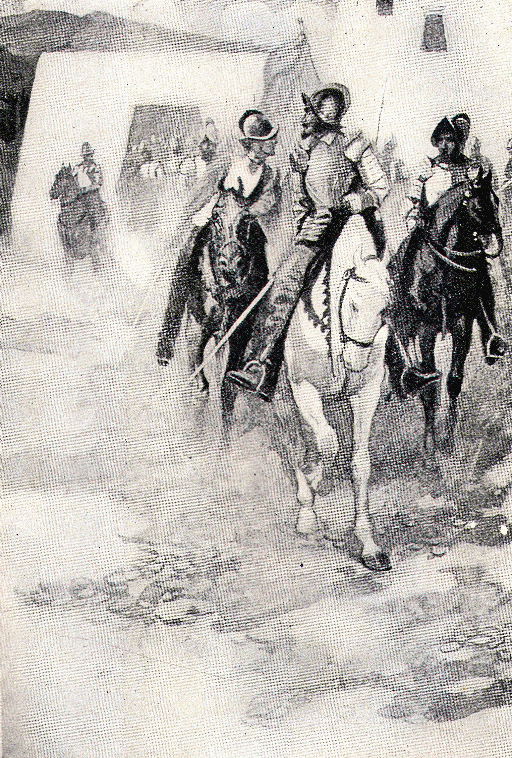 The three Pizarros . . . sallied out to meet them in South American Fights and Fighters |
 He threw his sole remaining weapon in the faces of the escaladers. in South American Fights and Fighters |
If you will let me go free, Pizarro, I will fill up this room with gold.' in The Men Who Found America |
 Atahuallpa, Inca of Peru in Ferdinand De Soto and the Invasion of Florida |
Peruvian Warriors in Pizarro and the Conquest of Peru |
The capture of Atahualpa in Pizarro and the Conquest of Peru |
The assassination of Francisco Pizarr. in Pizarro and the Conquest of Peru |
 De Soto in the Inca's camp in The Adventures of Pizarro |
 Pizarro's entry into Cuzco in The Adventures of Pizarro |
|