Spanish Conquest of Mexico
1519 to 1521
Spanish Conquistadors and Allies — versus — Aztecs of Mexico
First Approach — 1519-1520Conquest of Tenochtitlan — 1520-1521
 |
Cortez was unquestionably brutal and merciless at times, but on the whole, he was an exceedingly skilled tactician and a charismatic leader of men. He accomplished a great deal by diplomacy and treated his Indian allies fairly. He had several Indian children whom he acknowledged and provided for, and won the respect of many native leaders. If his plans had not gone awry he might have conquered the Aztec empire with little bloodshed, and he might have ruled the empire with more regard for the natives than the Spanish viceroys did. As it was, however, the fight to conquer the Aztec capital was a ferocious one, and Cortez was essentially shut out of government after the conquest.
The conquest of the Aztec Empire proceeded in two phases. During the first phase Cortez made contact with coastal tribes and made his approach to Tenochtitlan, the capital of the Aztecs. His men spent several months living peacefully among the Aztecs in their capital city, and got Montezuma, ruler of the Aztecs, into their power. While Cortez was out of the city, however, his captains got wind of a plot against the Spaniards and in a disastrously executed attempt to ward off danger, massacred a number of Aztec priests. This caused the Aztecs to rise suddenly and fiercely against the invaders, and drive them from the city.
From this point on, the gradual encroachment of Spanish power came to an end and desperate military and diplomatic measures won the day. Even after a frantic and bruising retreat, Cortez needed to convince the enemies of the Aztecs that the Spaniards could prevail against the fortified city of the most feared warriors in Mexico, even with a dramatically outnumbered force. He succeeded in persuading dozens of tribes to turn against the dominant Aztecs, and for almost a year, prepared for war. After a long siege, the city of Tenochtitlan was destroyed and the Spaniards gained control of the most powerful empire on the North American continent.
First Approach : 1519 to 1520
 |
The fleet of Cortez first touched land on the Yucatan Peninsula. There they rescued Geronimo de Aguilar, a shipwrecked Spaniard who had lived among the Mayas for many years, and could serve as a translator. Shortly thereafter, he acquired an even more valuable asset. At Tabasco, he was presented with 20 slave women, one of whom spoke the Aztec language. This woman, named La Malinche, or Dona Marina, became an invaluable translator and advisor to Cortez and was by his side through most of the conquest. Between Aguilar and Dona Marina, Cortez now had a way to communicate with most of the tribes he encountered and was also provided with insight into native customs, tribal alliances, and local gossip.
Cortez eventually settled on Veracruz as a base of operations and set up a fort in the region. The Aztecs were aware of the presence of foreigners on their eastern frontier, and sent an envoy requesting that they do not approach Tenochtitlan, the capital. The beautifully crafted gold gifts he presented, however, only served to enflame the Spaniards' interest. At this point, in order to discourage retreat or treachery, Cortez ordered all of his boats burned. His men would either conquer or perish.
Cortez was told that there were two tribes that lay between he and the Aztecs. The peaceful Cholulans and the war-like and incorrigible Tlaxcalans. He knew it would be fatal to leave hostile forces behind him so he approached the Tlaxcalans first. They were enemies of the Aztecs, but they would have nothing to do with the Spaniards, and prepared for war. They Tlaxcalans tried ambush, fought ferociously, and refused the Spaniards entreaties for peace until they were thoroughly beaten. At that point, they submitted, and became the Spaniards' most loyal and valuable allies. Cortez now approached Cholulan territory. They made peace offerings to the Spaniards, but on later reports that the Cholulans planned to destroy them by treachery, Cortez ordered a massacre of the entire population. These incidents epitomize a great deal of Cortez's character. He admired and rewarded courage and forth-rightness, but abhorred cowardice and treachery. He could be magnanimous or utterly merciless.
By the time Cortez arrived in Tenochtitlan, his reputation preceded him. He was received graciously by Montezuma, the ruler of the Aztecs probably because he believed the Spaniards had supernatural powers. Within a month Cortez had Montezuma in his control, but did not at the time use any violence against the Aztecs. Cortez hoped to conquer the Aztecs peacefully by conversion of the natives, and coercion of the ruling class. After three months of patient negotiation, however, Cortez's enemy Velasquez sent a large fleet with orders to arrest him. As soon as Cortez heard this he took half of his forces to the coast. Cortez struck by night, completely defeated the new arrivals, and to add insult to injury, talked the greater part of Velasquez's men into joining him in the march back to Tenochtitlan. In the month that Cortez was gone, however, the Spaniards had committed a massacre against the Aztec priests, and the whole city was in arms on his arrival. Cortez tried to maintain calm, but to no avail. The Spanish army had to sneak out of Tenochtitlan under the cover of night, but they were discovered, and a desperate battle ensued. The Spaniards were surrounded and outnumbered dozens to one. A third of their number were killed and many more injured. This was the famous La Noche Triste.
| Date | Battle Summary | |
|---|---|---|
| Massacre of Cholula (Conquest of Mexico )
spanish victory
In October 1519, Cortez and his army of Spaniards and Tlaxcalans marched on Cholula and were received into the city. On the report that the Cholulans planned to destroy the Spaniards by treachery, the army massacred 3,000 citizens and burned the city. | ||
| Battle of Tlaxcala (Conquest of Mexico )
spanish victory
Fought September 1519 between the Spaniards under Cortez and an army of Tlaxcala warriors under Xicotencatl. After numerous engagements, and an attempted night ambush, the Tlaxcalans submitted to the Mexicans and were thereafter faithful allies. | ||
| Battle of Narvaez (Conquest of Mexico )
cortez victory
Fought May 24, 1520 when a small force led by Cortez made a night attack on the Camp of Narvaez, a Spanish army of 900 sent by Cortez's enemies in order to arrest him and assume control of Mexico. The forces of Narvaez were caught completely off guard and captured. On hearing the tales of Cortez's men, the agreed to join him in his march back to Tenochtitlan. | ||
| Battle of La Noche Triste
(Conquest of Mexico )
Spanish victory
Fought June 20, 1520, when the Spaniards, under Cortez, who were evacuating Mexico during the night, were attacked by the Aztecs, and suffered heavy loss. The Spaniards called this event the "Noche Triste." | ||
| Conquistador who landed in Mexico with a small army, and allied with local tribes, conquered the Empire of the Aztecs. | |
| Ruler of the Aztec empire at the time of the Spanish conquest. Captured by the Spanish and killed during revolt. | |
| Indian slave woman who acted as consort, advisor, and translator for Cortez during his conquest of Mexico. | |
| Conquered Cuba for Spain, and was its first governor. First a supporter, then a rival of Cortez. | |
| Commander sent by Velasquez to arrest Cortez and take over his expedition. | |
| Conquistador who accompanied Cortez on the conquest of Mexico, and wrote an account of the incidents. |
Conquest of Tenochtitlan : 1520-1521
 |
The Spaniards eventually made their way back to Tlaxcalan territory, and began to form a plan for the conquest of Tenochtitlan. Cortez had already made several important alliances. Ixtlilxochitl II, an exiled prince of Texcuco, believed himself to be the rightful heir to the throne, and agreed to aid the Spaniards. Texcuco was very close to Tenochtitlan, and Ixtlilxochitl and his rebels became invaluable allies. The subject tribes in the region were required to pay tribute to the Aztecs, and in some cases were forced to provide human sacrifices to their conquerors. Under these circumstances it is not surprising that many began to look to the Spaniards to help free from the Aztec yoke, and some were even willing to adopt the foreigners' religion.
Another incident that worked greatly in favor of the Spaniards was a smallpox epidemic, which struck Tenochtitlan with great severity during the months that the Spaniards were recuperating and planning their next assault in Tlaxcala. This decimated the population and made it difficult to counter the Spanish diplomatic success in recruiting the surrounding tribes. Instead of raising another army to march against the invaders, the Aztecs fortified their city, and prepared for a siege. The city itself was built on an island in the middle of a lake and could only be approached by way of a series of causeways. It was understood by all that a siege would be a very difficult undertaking, and the Spanish spent many months planning the venture. Boats would need to be built to form a navy, bridges would need to be constructed, and portable siege weapons would need to be assembled.
In February, 1521 Cortez moved his base of operations from Tlaxcala to Texcuco, a city that was just across the lake from Tenochtitlan. The siege preparations were enormously complicated and involved thousands of men. Finally, in May the aqueduct supplying the city was cut and the first Spanish forces moved in. The complicated causeways and canals surrounding the city made approach exceedingly difficult. The only parts of the city that were not well fortified had to be reached by boat. The operations proceeded slowly. Neither side was anxious to risk high casualties and both engaged in ambush and defensive warfare. The Spanish blockaded the city from receiving any supplies or reinforcements from outside, and Cortez offered generous terms of surrender. The Aztecs, however, determined to fight to the bitter end.
Eventually the attackers made a breach in the walls and were able to enter the city, but the Aztecs took up positions on every rooftop and continued the fight to the death. They refused all of Cortez's entreaties even when completely surrounded. Cortez found that he could not storm any buildings without suffering terrible casualties and gradually came to realize that he would have to destroy the city in order to conquer it. Although his original hope was to take control of the city intact and make it the Spanish capital, he could not afford the loss of life required to do so. Instead he bombarded every building with cannon and reduced the beautiful city of the Aztecs to rubble. Finally, in August 1521, the last Aztec emperor surrendered himself to Cortez.
Cortez had conquered Mexico, but he had done so as a renegade. During the conquest he had worked furiously to establish diplomatic relations with Charles V in hopes of being able to rule Mexico directly under the Spanish crown. Unfortunately, he had made too many enemies, and in the end he was granted wealth and estates but little part in the government of the newly conquered province. This was likely unfortunate for the indigenous people of the region, since Cortez had made treaties with his allies that the Spanish government was not inclined to keep. Cortez, who had fought beside the Indians, lived among them, and had Indian wives and children, had an abiding respect for the natives than was not necessarily shared among the Spanish nobility who came to rule the province.
| Date | Battle Summary | |
|---|---|---|
| Battle of Otumba (Conquest of Mexico )
spanish victory
Fought July 8, 1520, between 200 Spaniards, with some thousands of Tlascalan auxiliaries, under Cortes, and a force of about 200,000 Aztecs. The Spaniards, wearied by a long march on their retreat from Mexico, were intercepted by the Aztecs, and after many hours' fighting, were on the verge of defeat, when a charge of a few cavaliers, headed by Cortes, into the very heart of the Aztec army, so discouraged them that they fled in disorder. It is said that 20,000 Aztecs fell. | ||
| Siege of Tenochtitlan
(Conquest of Mexico )
spanish victory
The capital of Mexico was besieged by the Spaniards and their allies in May, and defended by the Aztecs, who had sworn not to surrender. The city was surrounded by canals, and too large be taken by storm without horrendous casualties, so the Spaniards systematically destroyed sections of it, razed them too the ground and filled up the canals. The Aztecs held out until the last section of the once beautiful city was in ruins. | ||
| Chief lieutenant and second in Command to Cortez during the conquest of Mexico. | |
| Able lieutenant of Cortez who played a critical role in most of the Spaniard's battles. | |
| Nephew of Montezuma who made an alliance with Cortez, and ruled as the last king of the Aztec. | |
| Aztec leader who replace Montezuma II. Surrendered to Cortez, but later killed by him. |
| Book Links |
|---|
Image Links | ||
|---|---|---|
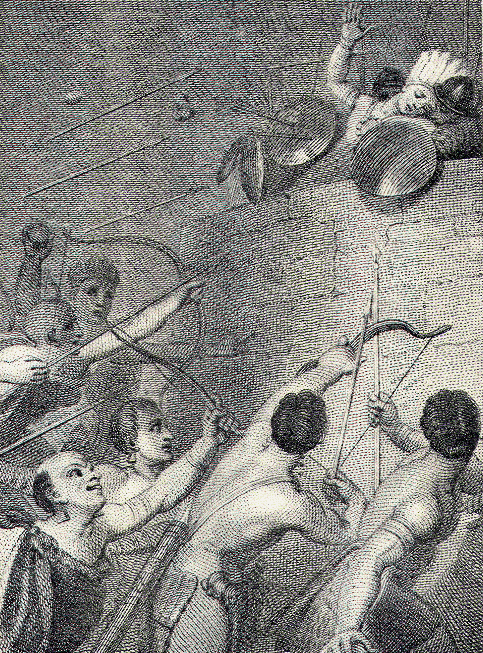 The Death of Montezuma in South American Fights and Fighters |
 Cortez in Battle in Famous Men of Modern Times |
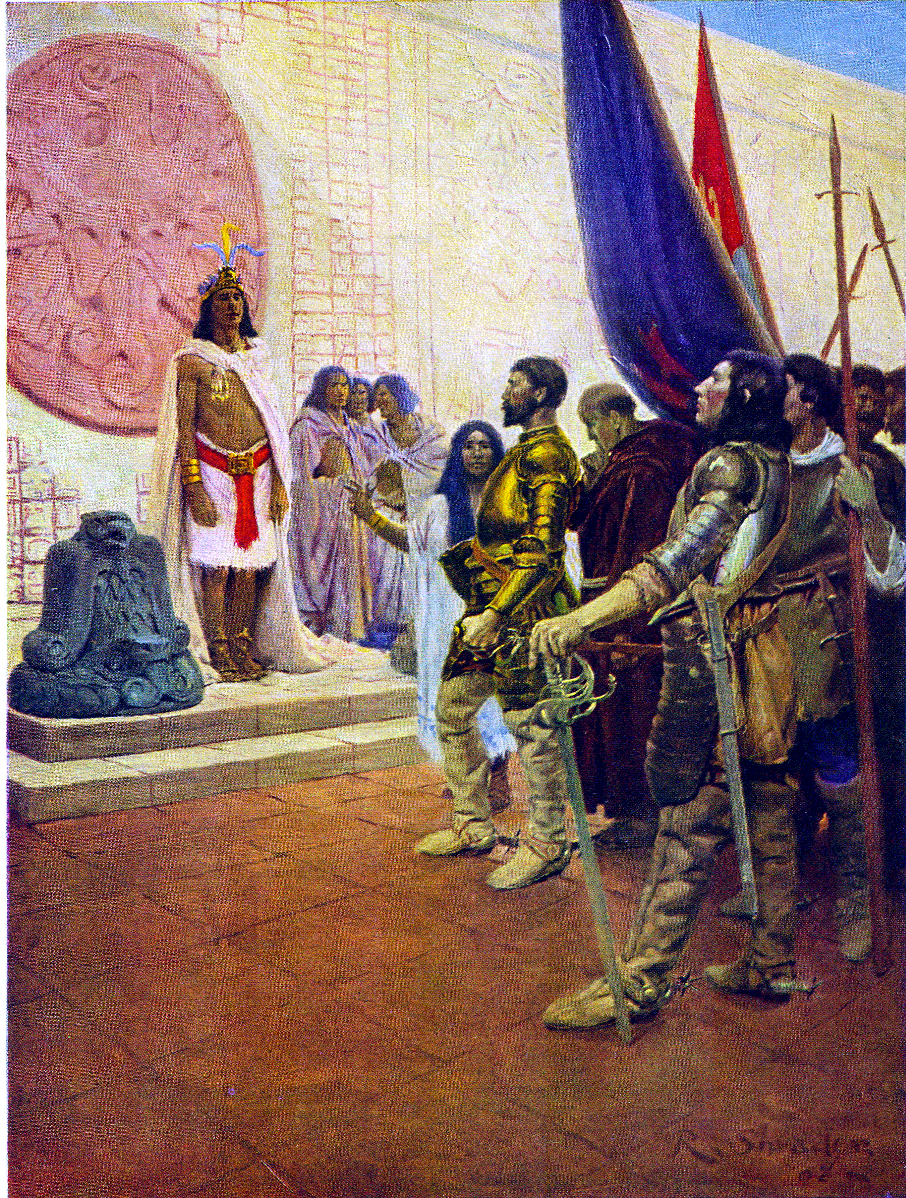 The kind King Montezuma wanted peace, and said that he would give the Spaniards more gold if they would only go back to their own country. in The Men Who Found America |
He fought boldly in the front rank in Mexico |
 To Mexico! To Mexico!' in Mexico |
 The whole army knelt in the mud and confessed their sins in Mexico |
 The army entered Mexico to the sound of martial music in Mexico |
Return to your homes. Lay down your arms.' in Mexico |
All sense of order and discipline was lost. in Mexico |
 'There is our mark! Follow and support me!' in Mexico |
 Again and again they returned to the attack. in Mexico |
 Cortes and his men at the gap in Mexico |
 The capture of the City of Mexico by Cortez in The Story of Mexico |
 Cortes at the Battle of Otumba in The Story of Mexico |
 The capture of Guatemoc in The Story of Mexico |
 Route of Cortez in Hernando Cortes Conqueror of Mexico |
 City of Mexico in Hernando Cortes Conqueror of Mexico |
|